
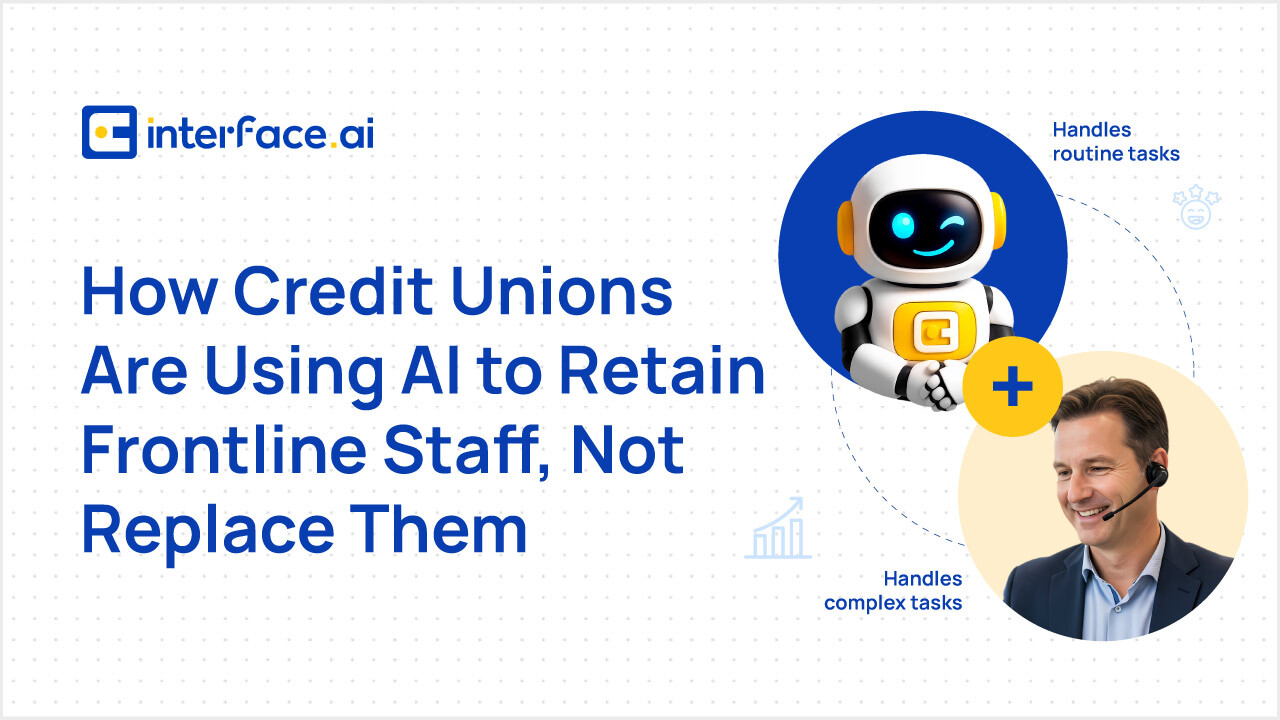
How Credit Unions Are Using AI to Retain Frontline Staff, Not Replace Them

Ask any VP of Contact Center Operations what keeps them up at night, and staffing is almost always in the top three. Not just hiring — keeping people once you’ve trained them.
The numbers are brutal. Contact center turnover industrywide runs between 30 and 45% annually. Average agent tenure has dropped to 13–15 months. Replacing a single agent costs somewhere between $10,000 and $20,000 — and that’s before you factor in the productivity gap during onboarding or the impact on member experience when an experienced agent walks out the door.
For credit unions specifically, 46% cited recruitment and retention as a top concern in Wipfli’s 2024 research. That’s not a HR problem. It’s an operational and financial one.
The good news: the credit unions that are getting this right aren’t solving it with better pay alone. They’re using AI – not to cut headcount, but to make the job worth staying in.
What’s actually driving agents out the door
Before talking about solutions, it’s worth being clear about the root cause.
74% of contact center agents report being at risk of burnout. When you dig into why, the pattern is consistent: it’s not the hard calls that grind people down. It’s the relentless volume of identical, low-complexity calls — balance inquiries, loan payoff requests, password resets, branch hours — day after day, with no real opportunity to apply their skills or build meaningful member relationships.
Agents who were hired and trained to help members navigate real financial problems spend the majority of their day answering questions that, frankly, shouldn’t require a human. That mismatch between what the job is supposed to be and what it actually is creates attrition. When an agent gets a better offer, or just needs a break from the grind, there’s no compelling reason to stay.
The AI opportunity: not replacement, redistribution
Here’s where the framing matters. The fear among frontline staff when AI enters the conversation is always the same: am I being replaced? The credit unions seeing real retention gains are the ones that answer that question directly — and prove it with how they deploy AI.
AI handles the repetitive, high-volume, low-complexity calls. Agents handle the rest — account disputes, financial hardship conversations, loan decisions, member escalations, anything that requires judgment, empathy, and relationship.
The result isn’t fewer agents. It’s agents who are actually doing the job they were hired to do.
WEOKIE Federal Credit Union is a clear example of what this looks like in practice. Before deploying voice AI, the credit union was in a constant cycle of losing agents burned out by high call volume and repetitive queries — and when people left, the remaining team absorbed an even heavier load. After deployment, 66% of incoming calls are now automated. The contact center stabilized at a consistent team of 17 agents, turnover dropped, and the credit union saved over $800,000 in a single year. One of their SVPs put it plainly: “The IVA will free up our employees from working on transactional activities and enhance the quality of work, thus improving employee morale.”
Great Lakes Credit Union took it a step further. After launching their AI agent “Olive” — which now automates 60–70% of calls during business hours — the credit union didn’t just redeploy staff time. They redefined the role entirely. Contact center agents shifted from transactional support into consultative, advisory positions. The change came with a higher pay grade and a clearer career path. Agents who stayed weren’t just less burned out — they had a more compelling reason to stay.
Getting the internal messaging right
One thing credit union leaders often underestimate is how much the rollout communication shapes staff perception of AI. If AI is introduced as a cost-cutting measure — even implicitly — the team hears it that way. If it’s introduced as a tool that makes their work better, the reception is entirely different.
The credit unions handling this well are having that conversation directly. They’re explaining what the AI will handle, what agents will continue to own, and what it means for their roles. They’re involving frontline staff in the process — piloting with teams, collecting feedback, iterating.
Change management is its own discipline, and it applies here. The technical deployment of voice AI is typically the faster part. The cultural adoption — getting agents to trust the tool and managers to adjust their workflows — takes more intentional effort.
The retention math
Let’s bring this back to numbers, because that’s ultimately how this gets approved.
If your contact center has 30 agents and you’re turning over 35% annually, you’re replacing 10–11 people per year. At $15,000 average replacement cost, that’s $150,000–$165,000 in direct turnover costs — not counting productivity drag, institutional knowledge loss, or the member experience degradation that comes with an undertrained team.
If AI reduces burnout-driven attrition by even 20–30%, the ROI on deployment pays back before you get to efficiency metrics. And the efficiency metrics — call deflection, handle time, cost per interaction — are substantial on their own.
The credit unions getting the most out of AI aren’t thinking about it as headcount reduction. They’re thinking about it as a way to make their existing team more effective, more satisfied, and more likely to stay. That’s a different investment thesis — and a more compelling one for organizations that care about their people.
The bottom line
The contact center attrition problem isn’t going away. If anything, member expectations are rising while the pool of people willing to do high-volume, repetitive support work is shrinking. The credit unions building durable contact center teams are the ones removing the conditions that drive attrition — and AI is the most effective lever available right now.
This isn’t about replacing your frontline staff. It’s about giving them a job they actually want to do.
Want to see how credit unions are deploying Voice AI and Employee AI to reduce agent burden and improve retention? Request a demo.
AI Insights for Credit Union & Community Bank Leaders
Join the monthly newsletter for all the latest industry updates
The Difference Between AI that Answers and AI that Acts – and Why it Matters for Credit Unions
Paid
Members
Public
A member calls to move money between accounts. Your AI answers. It tells her the balance. It confirms that yes, transfers are something the credit union offers. It suggests she log into online…
How Agentic AI is Moving the Efficiency Ratio for Credit Unions
Paid
Members
Public
In a CUInsight webinar featuring Navigator Credit Union and Red Rocks Credit Union, the conversation focused on what AI in the contact center looks like in production—not in pilots or theory, but at…