
What “Agentic” Actually Means for Your Credit Union’s Contact Center
AI Insights for Credit Union & Community Bank Leaders
Join the monthly newsletter for all the latest industry updates
No spam. Unsubscribe anytime.
“Agentic AI” now appears in nearly every vendor pitch targeting credit unions. The problem is that the term is being applied to systems with very different capabilities – from traditional chatbots with a new label to platforms that genuinely reason, act, and resolve member issues end-to-end.
For contact center leaders evaluating their options, the distinction matters operationally. It determines whether your AI investment deflects calls or resolves them – and whether it changes your cost structure or just adds a layer on top of it.
This post breaks down what agentic actually means, how it differs from previous AI models, and what changes when it works as intended.
What previous AI models in the contact center do
Before getting to agentic, it helps to be clear about what came before it.
The standard model at most credit unions looks roughly like this: a member calls in, navigates an IVR tree, gets routed to a queue, waits for an available agent, and then explains their issue from the beginning. If the issue is complex or falls outside that agent’s specialty, it gets transferred – and the member explains again.
Some institutions have layered in chatbots or voice bots at the front. Those bots handle scripted flows well: check a balance, confirm a routing number, report a lost card. Anything outside the script either fails or bounces to a human. The bot and the human operate as two separate systems. The handoff is abrupt. Context rarely transfers cleanly.
This is the bot-plus-human model – and it describes most previous AI deployments in credit unions. It’s better than nothing. It’s not agentic.
What “agentic” actually means
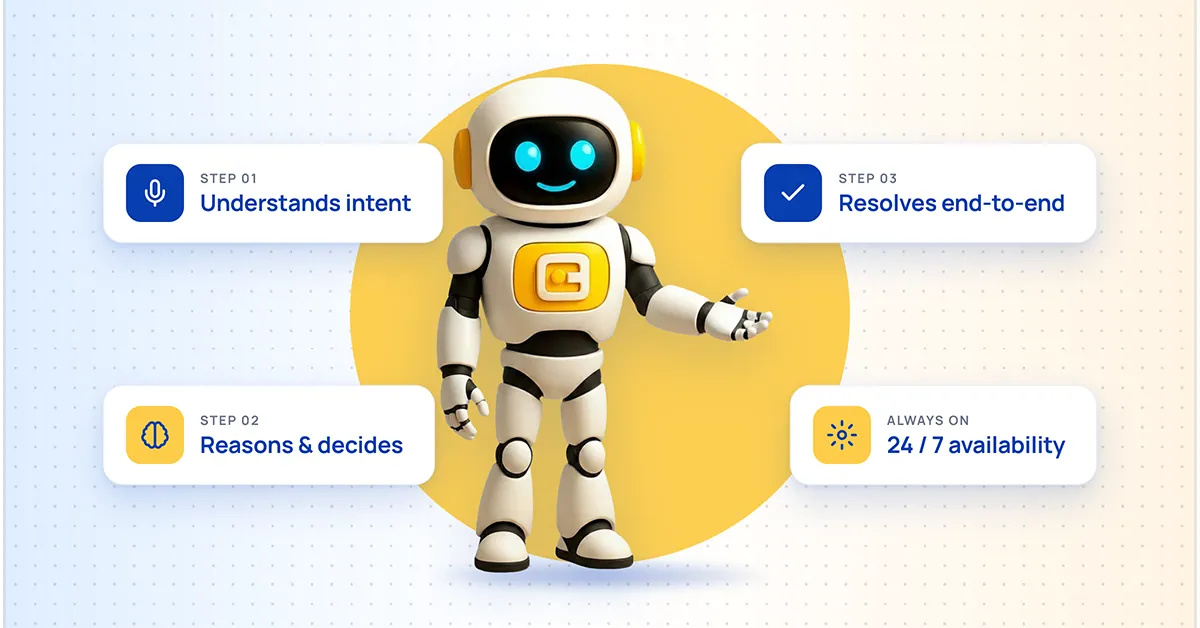
An agentic AI system doesn’t just respond – it reasons, plans, and acts toward a goal. The distinction matters.
A traditional bot matches your input to a pre-written response. It’s pattern recognition with a menu. An agentic AI understands what you’re trying to accomplish, figures out what steps are required to accomplish it, executes those steps — including pulling live data from core systems, verifying account information, applying policy rules — and confirms the outcome. If something changes mid-conversation, it adjusts.
In a contact center context, the difference shows up in resolution. A scripted bot can tell a member their balance. An agentic AI can identify that a fee was incorrectly applied, verify the member’s eligibility for a waiver, apply the credit, update the CRM, and confirm the resolution — all within a single conversation, without a transfer.
The key attributes that make a system genuinely agentic: it can access and act on live systems (not just retrieve static information), it can reason across multiple steps to reach a resolution, and it maintains context throughout the conversation so the member never has to repeat themselves.
3 things that change with agentic AI
When a contact center shifts to an agentic model – not a bot layer on top of the existing stack, but a genuinely agentic architecture – three things change at once.
1. Resolution replaces deflection.The goal of a traditional bot is to deflect calls. The goal of an agentic system is to resolve them. When members get actual answers – not redirects – they don’t call back. That means your queue stays manageable not because volume is being suppressed, but because issues are getting closed the first time.
2. AI owns the conversation. In a bot-plus-human model, the AI is a gatekeeper – it handles what it can, then steps aside. In an agentic model, the AI leads the full interaction from start to finish. Human expertise is available throughout, but it arrives at the specific moment it’s needed, not as a handoff that resets the conversation. That’s the core of how Nexus works – AI owns the conversation end-to-end, routing micro-requests rather than entire calls, so members never hit a hold queue and never have to repeat themselves.
3. Agents do different work. When routine volume is handled end-to-end by AI, agents stop spending their day on balance inquiries, address changes, and payment confirmations. They handle disputes, complex loan questions, hardship conversations – the work that actually requires judgment, empathy, and institutional knowledge. That shift in job content is one of the primary reasons contact center turnover drops at institutions that deploy AI this way. The work moves from transactional to advisory – and that change shows up in retention data.
Navigator Credit Union now automates 70%+ of calls with agentic voice AI – and has eliminated their third-party after-hours service costs entirely. Agents are handling the work that actually requires them. Members are getting answers without waiting.
See how Navigator Credit Union got there →
The bottom line
Agentic AI is not a chatbot upgrade. It’s a fundamentally different architecture – one where the AI is the primary operator of the conversation, not the first line of defense before the “real” service starts.
For credit unions, the operational case is clear: more resolution, less queue, lower cost, better agent retention. The member experience case is equally clear: they want their issue solved, not deflected.
The word “agentic” will keep getting used loosely. The concept it describes – AI that reasons, acts, and resolves – is the standard your contact center should be measured against.
See what a genuinely agentic contact center looks like in practice.
Request a demo of Nexus →Kate Rogerson
AI Insights for Credit Union & Community Bank Leaders
Join the monthly newsletter for all the latest industry updates
No spam. Unsubscribe anytime.
You might also like

Agentic AI for Credit Unions and Banks – The Questions You Should be Asking
“Agentic AI” is the most-pitched phrase in banking technology right now. Every vendor claims it, few define it the same way, and the demos all look impressive. For the leaders actually signing the…
Kate Rogerson July 24, 2026Agentic AI
Members Don’t Hate Automation. They Hate Bad Automation
There’s a stat that gets used to argue members will never accept AI: 80% of consumers who use a banking chatbot walk away more frustrated than when they started. Nearly the same share…
Kate Rogerson July 16, 2026Agentic AIAI Insights for Credit Union & Community Bank Leaders
Join the monthly newsletter for all the latest industry updates
No spam. Unsubscribe anytime.