
WeStreet Credit Union’s Evolution IVR to AI Call Automation
WeStreet Credit Union deployed Voice AI to solve what most contact centers struggle with — after-hours gaps, high-volume surge days, and a full core conversion that sent call volumes through the roof. The result: a leaner operation, staff freed from routine calls to focus on conversations that actually matter, and a contact center that’s evolving from cost center to revenue driver.
Watch now68%
call automation
6,000
after hours calls handled per month
1 FTE
reallocated through automation
Key Takeaways
When WeStreet's core conversion sent call volumes skyrocketing, Voice AI kept service consistent and even reduced wait times
No engineers needed - WeStreet built and scaled their AI contact center without any internal technical resources
WeStreet is now shifting the contact center from a cost center to a revenue center, using AI for upselling and proactive member insights
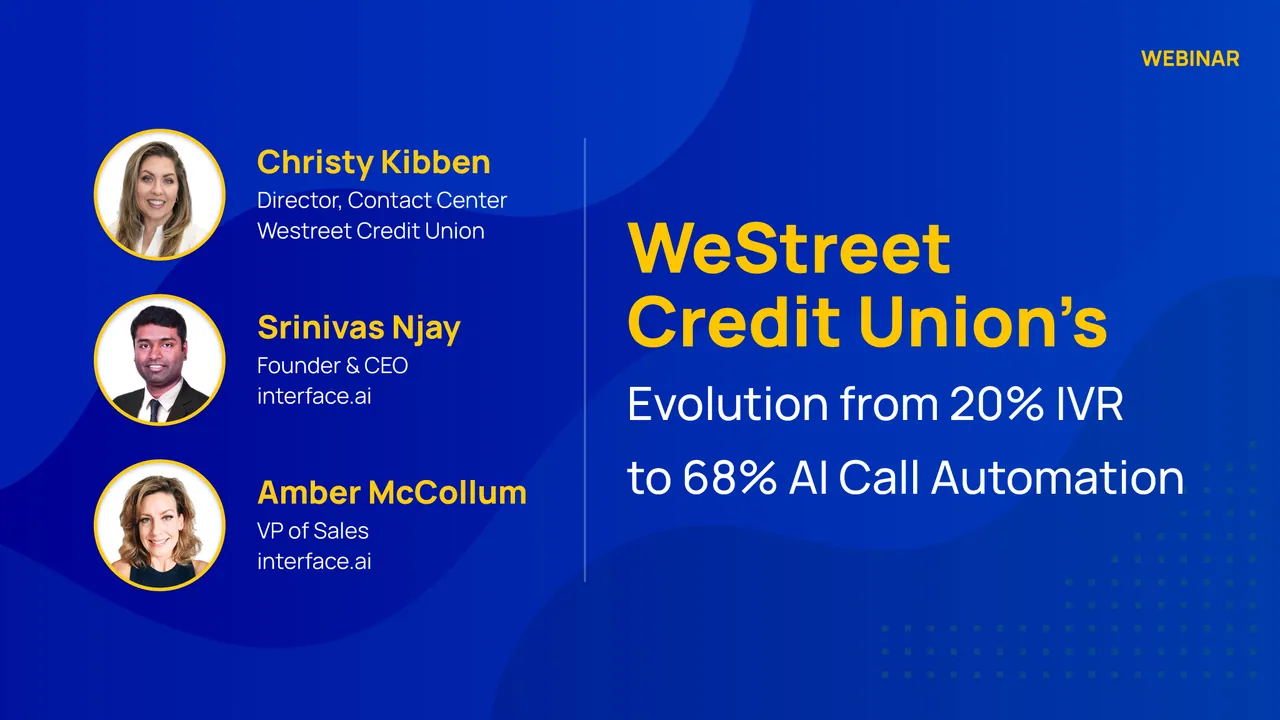
Speakers

Christy Kibben,
Contact Center Director, WeStreet

Srinivas Njay
CEO and Co-Founder, interface.ai
Transcript
Hi, everybody. Welcome to our monthly webinar from Interface dot a I. Today, we’re so excited to have Christy Kevin with us from WeStreet Credit Union. And today, we’re gonna be talking about how WeStreet had an evolution from twenty percent IVR to sixty eight percent AI call, automation. We’re super glad you joined us today, and I’m gonna take you through the agenda and a little bit of, interactive poll next.
So today, we’re gonna talk a little bit about Interface dot a I, a little bit about our history and where we’re headed. We’re gonna do some demos for y’all today, which I know you’re excited about. And then we’re gonna get to the main event, is our case study with WeStreet Credit Union. And then last but not least, a few minutes for some q and a.
So with that, let’s kick it off with a quick little quiz or a poll. If you if if you guys would like to participate, we always wanna hear more about what’s going on.
So the poll today, we wanna know a little bit about what describes your role at your financial institution. Now if you wanna promote yourself to CEO, you can, but we’d prefer to know your real role.
We’d wanna hear a little bit more about how you describe your current use of AI here and how do you think that affects your member or customer experience.
And then we’ve got a couple more questions on the next slide.
We’re gonna ask you a little bit more about your AI strategy, where you’re at with that, and then we’re gonna ask you your level of knowledge and comfort too with, for example, Agenic AI.
And then we’re gonna bring those poll results here back for you in a minute. So I’ll just give you a second.
Oh, yes. And we’ll be asking you too. I almost forgot to say, your biggest concern about using AI, this is always a really good one to share.
So as soon as we get everybody’s inputs, we’ll share those results.
Alright, team. Let me know when you’re ready.
We should probably give a minute.
I see.
Here we go. We’ve got the results.
It looks like we’ve got a really interesting mix today. We’re pretty excited to kick this off.
As I look here, yeah, a really nice subset. So let’s go ahead and get started. I’m gonna do some quick intros of the group today.
First off, we have our guest of honor, which is Christy Kiven from We Street Credit Union. She’s, up here as one of our panelists today. Give a little wave there, Christy. Then we have Shrinivas Njei, our CEO of Interface dot a I, and then myself, Amber McCollum, VP of sales. And I think with that, Shuri, I’m gonna turn it over to you.
Wonderful. Thank you, Amber and, Christy. Thanks for joining, on this webinar. It means a lot to us. I really appreciate it for the partnership.
You know, for everyone who joined on the webinar, thank you for making time. This is Sri. I’m the cofounder CEO. Really excited about taking you through this next ninety minutes to introduce you about Interface AI and v Street Journey with their AI product deployments and the outcomes and the member experience improvement they have driven through several years of partnership with us.
Before we get started, I wanna take a few minutes to introduce you about the company, and we also show you a demonstration of a product that we street is using today. So you have little more context going to listening to this journey of we street from Christie in a few moments. So interface AI is been around for over eleven years. It’s the longest standing AI vendor.
We’ve been doing AI before AI was cool. Right? So we are headquartered here in California, San Francisco, close to a hundred and seventy employees. We’re also a QSO.
Interface AI you know, AI can do so many things today, but we squarely focus on, you know, using AI to improve, you know, self-service for your members and customers as well as for your employees. Right? So that’s our sweet spot and our focus area, you know, whether we call it, like, Beng GPT platform, which does that.
And, you know, pretty much, we have been, featured in Gartner as the best AI, vendor for credit unions and community banks. Financial institution community financial institution is the only industry we serve. This is a platform purpose built, for just for financial institution. We’re also, featured, on Allied Solution and, you know, America’s Credit Union now, including we won several awards at Finowate and American Banker as a best AI award.
We serve over hundred financial institutions today with close to two hundred fifty three hundred AI deployments with multiple products.
I personally come from a a credit union family myself. My father started a credit union, scaled it up to a couple of billion, you know, helped them through some technology strategy. But I also previously worked at Microsoft, part of the AI research lab, and, you know, bought both experiences together to build interface dot AI at squarely at the intersection of my personal exposure to credit union and my professional exposure to AI. Bruce Kim, my cofounder, CTO, you know, he’s extremely proven enterprise architect, built world’s first billing SaaS company, and he joined me on the journey to start interface dot AI as a CTO.
You know, it’s been an exciting ride serving so many financial institution like WeStreet and the others.
And, you know, we probably are the most ambitious and big visionaries in AI you’ll come across. And in terms of, you know, not having that ambition, also executing towards that, here is kind of the plan we laid out for ourselves for the next three to four years. Right? Everything on the left is something that we already do.
On the right in blue are the ones that we are are our road map. Right? So if you look at the left, today, we are this one AI brain for all channels of communication. So pretty much, you know, you could plug in our AI brain for your chat, voice, you know, interactions with or within online mall banking and things like that for interactions to automate it from your members and customers or the financial institution.
It can also be an AI that you could plug in on on your Microsoft Teams for your employees and whatnot. So it’s a one AI brain. You train it once and deploy across all channels for your both your members, customers, employees. Right?
So this AI is not just, you know, you know, takes a task or automates it. It’s also, you know, AI that drives more intelligence in those conversation, trying to find an upsell cross sell opportunity or a financial insight, you know, pretty much, you know, it automatically drives revenue for your organization. Right? So so it’s it’s a very it’s a enhanced intelligent conversation that it has rather than just taking instruction and executing.
Right? It’s finds offers that may be interested, finds insights that may be important for you.
During the conversation, we bring it up and things like that.
And behind the scene, we also use a computer user agent in like, it’s a fancy word for intelligent RPA, where even if your system if your if if your systems that AI needs to connect to doesn’t have APIs, we have ability to use an intelligent RPA still process request and complete task. Right? So that’s kind of the integral part of how we’ve ensured the AI is agentic, and it fulfills the request, you know, instead of just giving information. Right? It goes beyond the APIs.
And end of the year, we are working on, you know, launching an our entire online mobile banking replacement. So we are not just an AI within the channel. Our bigger vision is to take our entire self-service and make it AI first. So in the process of doing that, we’re also launching our own AI first online mobile banking.
Fully agentic, nothing like that exists in the world today. It’s a it’s a pretty exciting step. We’re going live with one of the California credit unions here close to us. They’re replacing q two in their journey doing that.
So what’s the future holds? You know, very soon, this our AI brain today, of course, is limited to one financial institution. So if your member have this AI access through call or chat or through online, you know, or or agentic online mobile banking, they can only interact with your accounts. Right?
But where we are going future is very soon, they should be able to add multiple financial institutions so they could bank across all of the financial institution, use the AI you provided to them as a universal banking assistant. Right? So that’s kind of where we’re going next. And now that the the AI has a full context, it has a way to proactively provide tips, suggestion, and drive their financial goals a little more, you know, autonomously in the future.
If we are able to get there, I think when you know, if if today we’re able to drive a car from point a to point b without us driving, really, so our big goal of autonomous banking is can we also have our members’ financial goals driven autonomously? And if we do get there and the technology, it it we’re not gonna be too far from driving AI to do universal basic income. AI could promise a universal basic income. Right?
So it’s a pretty ambitious, you know, future we are betting on. And, you know, thanks to AI, it’s getting very powerful every day. It helps you to aim bigger and bigger. You know, I personally feel AI could fundamentally solve all of our industry problems.
Right? So it’s exciting exciting future ahead. So, you know, we we talked about that, like, you know, towards the end of the year. We’re replacing online more banking, you know, the vision of having our AI sort of entire self-service.
You know, that’s a very different journey of AI you could take with us compared to, let’s say, other traditional AI vendors out there. Like, you know, the typical promise you get from a traditional AI vendor is, hey. We’re gonna add AI to your voice and chat. The AI could automate the calls or chat interaction.
But only thirty percent of your member interactions are happening through voice and chat. Right? Sixty, seventy percent of interactions happening through online mobile banking. But if your voice and chat is an intelligent experience, but your online mobile banking is a dumb experience, doesn’t make any sense.
So that’s our approach is to ensure we create an AI native online mobile banking so a hundred percent of your interactions are intelligent for your members. Right? So that’s a different journey you’re gonna take with us. Right?
So and, you know, this is our, you know, kind of bank GPT platform vision.
You know, as you adopt multiple solutions so far, is how your tech stack should look like. There is, like, a chat GPT, like, assistant for your members that can be accessed through voice or chat or by itself as a replacement online mobile banking. And that chat g p d like AI system will be insightful, drives, automates every request. It drives revenue by suggesting products and services.
It learns about your member preference and customer preference over time and personalizes it, and it ensures it is those interactions are extremely secure more than that is done today. Right? Using unique AI methodologies to make it secure. So that’s on your member side, which is on the left side. On the right side, you know, it’s the same AI brain that, you know, uses the same integration that’ll be used by your employees. Your employees are also gonna have a ChatGPT like, you know, interface that they would go into to either help a member as a frontline staff while members calling or chatting or even on the branch.
You know, a frontline staff should be able to use this one stop shop where the AI provides instant access to knowledge, able to take action, and also coaches those frontline staff to upsell, cross sell. So it’s the same AI brain. You know, it connects to the same systems, but it completes different kinds of workflows. Right?
So that’s kind of the part of one AI brain is a watch your sloop that helps you. The moment you make AI better for your employees, it automatically becomes better for your members and other way around. Right? So that enables a watch your sloop for you.
So that’s kind of the BangGPT kind of platform what what we talk about. So we are fully agentic AI underneath. I saw in the poll that some of you kind of talking about these terminologies are not that familiar. So this is probably the simplest way to explain the difference between all these technologies and the all the buzzwords you’re hearing.
You know, this has been our technology evolution too as a company because we’ve been around for a long time.
You know, ourself, if you look at on on the extreme left, we were NLP bots, like, three to four years back, which is, you know, the simple framework I used to explain this diff different technology is request and response, which is how did AI understood your member request, and how did AI fulfill your member request? So that’s, like, a simple framework to understand the difference in this technology, request and response. So in the age of NLP bots, your member request for AI understood very poorly. It had to be extremely the responses has to be extremely scripted. So even the responses were poor. Right? This is where tech all of our technology was, especially I was being doing this for a long time, you know, three to four years back.
And then the Chargeability happened in twenty twenty two. Immediately, the technology was available to make something better. So what we call partial generative AI era, which was two years back, which is where the request, as in AI got really good in understanding a member request.
You can ask the question in multiple ways, and it figured it out, got smarter. But your response that member used to get was still scripted.
Right? You had to sit and write every script and all of that. Unfortunately, still, there are a lot of offerings in the industry who are stuck there, which is partially generative AI. And then about a year and a year and a half back, we moved to fully generative, which is the request continued to be superior.
You didn’t have to manually train for the AI to understand your member request. So it got better. But the response also got better, but it was only for informational query, which is like, hey. What is my routing number?
You know, what are the auto loan interest rates? It it got better in looking up your website, quickly finding the right answer, things like that, but it still failed to do transaction autonomously. Right? So it was not agentic.
So that’s literally where we are today. And, you know, six months back, we launched our agentic platform. So now if you look at, apply the same framework, which is request and response, the request is extremely superior. You you know, you can just speak long sentences and things like it’ll really understand well, empathize with you, understands your tone, not just the words, the tone of your voice and things like that.
And the response is far superior. It’s almost like training a human being. Right? Like, not only for informational queries, like, you know, what is your routing number or, you know, find me an auto loan interest rate.
But it even when you’re asking those informational questions, you’ll see it always has a follow-up question. You know, it it gets it it asks you smart question to nudge you. Right? But for transactional, it got really superior.
Right? Like, you you you now provide integration and constraints. What are the dos and don’ts? And it’ll figure it out.
And you don’t have to sit and script every single API call and things like it. It actually figures it out and does the transactions.
Especially using our intelligent RPA, it can even go beyond, you know, APIs and complete transactions navigating your application. That’s agentic. Hopefully, that gives you, like, a really simple framework to think about how to, you know, make sense of these buzzwords. Right?
Especially in the context of member and employee experience. Right? So these technology could mean different, let’s say, underwriting. Right? Because we focus on self-service, we created a framework for you to understand this technology in the context of self-service. Right?
So and as a company, we have lot of solutions.
We are the most capable AI platform for financial institution on self-service today for employee and member.
So we have multiple products all powered by bank GPT platform. You know, agentic voice, basically our voice AI that takes in incoming calls, which is what WeStreet has launched, and we’re gonna talk a lot about this.
We’re also gonna show you a demo. You know, Voice AI is basically picks up picks up hundred percent of incoming calls and uses agentic AI to fully autonomously handle a lot of questions, checks for fraud, and things like that.
And we also have chat AI, which is basically AI that you can chat with. Same AI brain. You can now chat with it and, you know, and and whatnot, and it helps you do transactions, find information, complete task.
We also have employee AI, which is really the other side of the same coin. If these two AIs unable to answer something, then it’ll it’ll actually route to an employee. And the employee AI helps your employee, you know, in fulfilling those requests that AI could not. So it finds a policy and procedure quickly or helps them take action and things like that. So with employee AI and the chat and voice AI, you your hundred percent of your member interactions are directly or indirectly powered by AI. Right? So that’s kind of the that’s those are the kind of the three suite of products that helps you achieve that goal of hundred percent AI enabled interactions.
And then you we also recently launched an AI for collection. So here, our AI was waiting for an inbound. So when someone starts a conversation, it used to answer questions and, you know, drive upsell, cross sell, and complete task.
But recently, we took one more major step where our AI does outbound. Right? So where AI fully automates the entire workflow of, you know, collection with a multichannel outreach and collection. Right?
So it automatically reaches out on email, escalates to text, escalates to a call, following all the policies and things like that. Right? So that’s kind of the first step on an outbound, and it’s pretty effective for early stage delinquency and whatnot. And this is the one coming end of the year, which is our online mobile banking replacement, which is fully, you know, agentic online mobile banking, AI first, and things like that.
Another exciting news for you, last week, we launched a entire agentic contact center system.
You know, imagine if entire contact center software, like the ones we use Genesis or Avaya or Cisco or, you know, you know, imagine if those were built in today’s era with completely using all the latest and greatest AI tech. What would the contact center system would look like? That’s exactly what we did with agentic contact center system, which was launched last week, and we’re gonna show you a demo of that too.
And both collection and the agentic contact center system is in a pilot, and we are open to taking a small set of customers to pilot and, you know, you know, build that build that out. Right? So that’s our overall stack. Right? So all these three solutions been around for several years, very mature products, and these are some of the new we are piloting with a few customers.
So we have a lots of integrations, many course you could imagine. We we have integrations to every single one of them, about twelve different course and things like that.
And we scale our solutions from as small as a three hundred million dollar assets financial institution to, you know, close to fifty billion dollars in asset. And very soon, we’re onboarding. We’re doing a pilot with one of the largest credit unions in the world. This is about a hundred plus billion.
So that’s a quick introduction to our solution where we spoke about some of these integrations already. With that, I would like to introduce you to offer one of our flagship product, which is what we street users today, which is our agentic voice AI. We’re gonna show you a quick demo so that you’re able to understand the product and you follow the follow the journey, you know, the discussion we’re gonna have with Christy here shortly. I’m gonna invite my colleague here, John, to help me with a a quick demo.
Please remember, this is the next version of vStreet’s AI. They are still on one version order, they are moving into the agent invoice soon. So we’re showing you their latest version. Right?
So but if you call today, we still you’re gonna see one version before. So just FYI.
And, John, can you help us with the demo?
Yep.
And just give me a moment to share my screen.
Alright. So as Sherry said, we’re gonna give a call to the AI agent live and have a conversation.
Hello. I am Alex. Welcome to WeStreet Federal Credit Union. Please note that this call may be recorded for quality assurance and training purposes. Your privacy is important to us. You can ask for my help with anything.
For example, you can say account balance, deposit status, transfer funds, transaction history, or loan payment. What can I help you with today?
Do you have any accounts for kids or children?
Sure. Checking on that now.
Lee Street Federal Credit Union offers a teen checking account for kids ages thirteen to twenty one. It earns dividends, has no monthly service fee with the statements, and lets parents monitor the account online.
It also includes in branch financial education.
I can text you these details if you What is the routing number?
One second. I will check.
The routing number for Wee Street Federal Credit Union is two zero three three nine eight six two six one. I can text this inform to you. Send a text?
Actually, you know, I need to check my account balance for my savings account. Can you help me with that?
Absolutely. Just a second. Would you like to use device biometrics for authentication?
Yes.
Sure thing. Just a second. I have sent you the text with the secure to authenticate.
Please provide consent to continue with device biometrics login.
Thanks. You’re authenticated. Let’s continue.
Your business checking account ending with seven eight nine zero has an available balance of one thousand dollars and a current balance of one thousand dollars.
Your vacation savings account ending with zero nine eight an available balance of two thousand dollars and a current balance of two thousand dollars.
Would you like to check the balance for another account?
No.
Based on your balances, you may qualify for a higher yield or premium account option that reduces fees and increases earnings.
With your combined balances, you could qualify for a premium checking account that waives monthly fees, earns higher interest, and includes perks like free wire transfers. Would you care about the premium account options available to you?
Yeah. That sounds interesting.
Great. One moment.
Great. Our premium checking includes higher interest, waived monthly fees, free wire transfers, and overdraft protection.
Since you already bank with us, the upgrade is quick. Would you like me to send you a text with more details?
Actually, I need to transfer a hundred dollars from my checking to my savings account. Can you help me with that?
Working on that request now.
You wanna transfer one hundred dollars from your business account ending with seven eight nine zero to your vacation savings account ending with zero nine eight seven. Is that right?
Yes.
Could I go ahead and Okay. One moment.
The transfer of one hundred dollars from your business checking to your vacation savings account is complete. It may take a little time to show up.
Would you like to check your recent transactions now?
Yeah. Could you list out my checking account transactions?
Sure. Pulling that up now.
Here are the transactions for your business checking account ending with seven eight nine zero. A monthly interest credit of forty five dollars on April twenty second twenty twenty six. A purchase of seventy five dollars at Souvenir Shop for beach towels on April twenty first twenty twenty six.
I I didn’t buy any beach towels. That sounds a fraud to me. Can you help me with that?
One moment while I check.
I understand your concern about the beach towel purchase. Right now, no representatives are available to take your call.
Please call us back during next business hours. Is there anything else I can help you with?
No. Thanks. Bye.
Thank you, John. Appreciate it. Hope we all got a chance to experience the agentic AI. It was able to not only answer questions quickly looking up WeStreet website, you know, answer some of the informational questions. It was also able to answer and complete many transactions from checking balance. If you notice during the checking balance, even as simple request that we all get, like, a million calls for that, he was able to use that interaction as a an opportunity to upgrades them to a premium checking account. So that’s, you know, that’s kind of the, like, nature of the AI where you’re taking as a simple service interaction and driving, you know, revenues and business and also helping the members with the right products and service.
And and then it was able to complete a fund transfer, was able to list out all the transactions. We on the fly, we enhance those in transaction descriptions we all get from the core, which is almost impossible to understand what they mean, the descriptions of the transaction. We actually enhance that. So that’s why you’re able to hear those descriptions very user friendly.
Right? In a beach towel, souvenir shop, and, you know, as a credit or, you know, it’s a interest credit and things like that. It was very user friendly. We enhanced those as well using AI.
And then when John said it could be potential fraud, you know, pretty much immediately was ready to transfer the call to our staff. Of course, we we didn’t wanna waste Restreet staff time. We didn’t forward the call to them. So that’s the overall experience for the agent AI.
You know, it’s pretty much, you know, drives those conversation autonomously helping with fraud fraud detection too. You know, you saw device biometrics. Basically, there was a link sent to John’s phone. When he clicked on it, it was pretty much using the face ID of John to verify that. So we offer multiple comprehensive forms of authentication.
Great. So, with that,
I would love to take a couple of minutes here to quickly show you our brand new product we just launched yesterday, which is our, Nexus, which is a world’s first fully agentic contact center platform. There is nothing like this exist today. We’re extremely proud to launch something like this, and I think we as an industry, Credit Union, Community Banks probably needs something like this the most.
And you’ll you’ll understand when you see that in action. So Nexus fundamentally changes the the the archaic traditional way we think about customer experience, which is, you know, the you know, we we think about customer experience in, a a binary, right, which is, hey. If AI cannot answer the call, you know, we forward the call, transfer the call, and the staff answers the call. So that’s a binary world we’ve been living in.
Right? So this is for the financial institution who already adopted AI. That’s how it’s been working. You have either AI answer it or a staff answer it.
But NexSys breaks that binary traditional approach. We’re introducing a new option, and and there’s nothing like that exists, which is basically a human in the loop. Like, because sometimes when a call transfer happens, the transfer happens because there was a thirty seconds human judgment required. But then, for that thirty seconds of human judgment, or wherever AR got stuck could be one step out of the ten steps, you ended up transferring the call.
But with Nexus, what happens is it’s the most seamless human AI symbiosis where the AI automatically seeks out an employee to come help while, you know, during a conversation so that a human could come in, quickly unblock the AI, and go away. That could take them ten seconds, and the AI con continues to engage the user. It never transfers the call. So your member also doesn’t know whether when there was a human involved behind the scene helping AI.
Right? So it’s super seamless. Right? So your member keeps talking to AI, and the staff comes in and helps AI to unblock so that AI continues the engagement, you know, without having to transfer.
Right? So that’s kind of, you know, what Nexus does is a completely new way new way of customer experience.
It helps AI to do a lot of things. And also for your staff, if they’re handling one call at a time with Nexus, they could be helping AI across thirty calls at a time because they’re not needed to take over the entire call. They’re needed for a microstep where they have to go unblock the AI, guide the AI, and they move to the next call. So that could have taken them ten seconds. So they could be handling twenty, thirty calls or chats at a time. Right? So that’s Nexus.
We’ll show you a quick demo.
You know, this is under pilot with a few financial institution, and we’re excited to show you this the early version of it. So this is how the future of contact center would look like.
John, if you can make the full screen, great. So, you know, know, your staff could log in. They could make mark themselves away. But if they come and say they’re available, immediately, AI assigns a task to them.
Hey. Here is a call. And if you go to the right side, scroll up, it’s a wire transfer. AI got stuck.
So it got the staffing involved to unblock by a login. If you scroll up, John, it shows you the entire transfer of the call. AI is still handling their call.
You know, it got stuck, so it got the human being to come and, like, enter the password. And now it automatically unblocked itself and says, hey, staff, can you authorize this transaction? Because as AI, I’m not authorized to do myself, so I got you involved. So the the staff does it.
They get the next task assigned. Right? So they don’t have to go through the entire wire transfer process. AI does nine steps.
They got involved for the one step. Right? If you see on the left side, AI automatically brings up the right software for them if they wanna take control and things like that. On the right side, it shows the transcript.
Here, the next task assigned to the staff member is is someone calling in, talking to AI to increase credit card limit. Ai says, hey, staff member. I need your help here. So it it seems like it’s asking to send, you know, additional documents.
And it seems the member said I’ve already sent to this email. The staff can quickly click the button, and the AI automatically scans their email, pulls the latest statement they’ve sent, and evaluates and keeps it for approval for your staff. So they click approve, and AI is handling the conversation of member. Then in order to even get involved.
And the next task get assigned. So, you know, this time, it seems like someone really wanted to talk to someone, so they requested a callback. AI took a callback. At this time, your staff would be assigned to make that callback, and it’s it already gave a summary of the call and prepared the staff, that someone is calling to, you know, this is for the loan application status.
Right? So they can quickly hit the numb hit the button there. It’ll start the call right there. So the AI is fully managing your staff time.
Right? Where where best their time is spent in bringing them into the loop. So here, it’ll doing a live transcription of their call happening between the member and the staff.
You know, of course, on the left side, it’ll open the right systems and screens as needed using our computer use agent.
And, you know, you can disconnect the call and, you know, the moment you do, it’ll automatically assign the next task to your staff. Right?
So AI is kind of managing your staff time or sending the right task, bringing the right place to get unblocked so that the conversation with AI continues without being having to transfer every time it can handle something.
So this is this enables like, if you noticed with quick actions that’s the staff was able to take, they were able to handle three to four calls in a matter of less than a minute. Right? So because they’re just needed for microstep, they need not to fully take over the call just because the human judgment was required for a small part of the workflow. Right?
So that’s the future of context in the system. AI on the front and, you know, AI, you know, orchestrating on the behind with your with your staff, bringing bringing them in the loop at the right time and completing transactions. Right? So with this, you can easily have AI reach automation levels up to eighty, ninety percent, you know, with human help you know, staff helping behind the scene.
And every time a staff is taking an action, it is learning. Right? So it’s learning, evolving, and getting better. So next time, it can keep using those interactions as an opportunity to improve automation.
So thank you, John. So that’s a quick demo there, for, for some of our new product. With that, I’m gonna hand it back to Amber, to take us through the journey of WeStreet with Christie.
Oh my goodness. This is my favorite part of the whole day is when I get to meet with our fantastic team. This is Christie Kippen, and she’s with us from WeStreet Credit Union.
Alright. Amber, give me one second. Jack, you’re sharing the wrong screen.
Oh. So while Jack is fixing that, Christie, thank you so much for joining us today. We’re gonna put the Credit Union’s little bit of a bio on the screen behind you here in just a minute. But as we’re getting that started, I wanted to just share with the audience a little bit about WeStreet Credit Union.
My favorite thing about you guys’ story is, a piece of what we show here, which it talks a bit about how it started. And I absolutely love the idea that this credit union started out of a humble cigar box. So, it looks like, as we sort of talk about that, there was six federal employees, in Tulsa, Oklahoma. They pooled their savings together, and they kept those savings in a cigar box.
So if you think about how far that your credit union has come from the cigar box to where you are today, which is just a little bit south of a billion in assets, a pretty remarkable story. So thank you for coming. Would you do a little intro of yourself for us?
Yeah. Absolutely. I’m so excited to be here and talk more about how Interface has helped us. I’ve been with the Credit Union for just over six years now. I’m the director of our contact center, and I oversee all of the call center operations, as well as our video tellering.
Amazing. Alright. Well, we’re gonna get right to it then. We’re gonna get to the first set of questions.
So tell us a little bit about how your business strategy was delivered more effectively with AI in general.
Yeah. Happy to. That’s a great question. So for us, it was we had a few things that we wanted to make sure to hit when we were looking for a software to help us with our IVR.
We don’t have after hour support or weekend support. So this really assists us so that members can get that help through the system when we’re not available to be here to help them. So that was an automatic hit for us.
And especially, you know, on those busier days, the beginning of the month or the fifteenth of the month when our agents are really busy, Members can get a lot of assistance through the IVR.
The other pay place is with our risk and compliance. It’s really important that we’re keeping our members safe and ensuring that we know who we’re speaking with. So we’re able to preauthenticate calls in the IVR, which has helped us in multiple ways, not only keeping members safe and ensuring who we’re talking to, but it also helps our average handle time since they have that authentication ahead of time. And then just automating those routine calls, you know, I mentioned about after hours, and this helps in both ways. If a member needs to call in and turn off their debit card, they can call right in and get to get the assistance that they need.
They can also get their balance and transaction history before they talk to one of us. So it really helped the areas that we were looking for. But then I think even when you think about future and where we wanna be, you know, when we signed on with Interface, it was back in twenty twenty two, and I think there wasn’t as much out there in other areas. So now we’re looking at underwriting for AI. We use Copilot among the teams within the whole credit union, and we really push it as well in our call center.
We also use, you know, the notes feature. We use Microsoft Teams, so we use that. It helps with our PMO team. We just implemented something with our knowledge base that team members can now ask questions to. So I think it’s just paved the way to even help people and team members become comfortable with using AI.
I love this. You hit on all the best points. Oh my goodness. So I’m actually gonna shift over now and ask Shree a question, and I’m really grateful that this font is so big because I don’t need my readers, which brings me to wish Shree a happy birthday today.
Thank you.
Happy birthday, Shree. What are the executives you’re talking to? What are they saying today about AI in their business strategy?
I think it’s a you know, vision visionaries like Christy have already led the path, kind of showing the industry doing this first and, like, leveraging that technology. I think, you know, she’s absolutely spot on lot of change, from the last couple of years. The ex the number of AI solutions are exploding, the the different kinds of use cases.
I think we’ve reached a point as a a recent conversation with another executive recently and and, one of the things we were discussing is we reached a point where AI is so good now that not offering AI is, you know, hurting member experience. But let’s say, you know, three, four years back because the technology was still early, offering AI was a little bit of a compromise. Right? If you had to work really hard to make it work really well for your members, but now not offering is a compromise. Right? So that’s a quite a bit of a shift, you know, in terms of the expectation of AI from our members.
Yeah. I think the the the there’s a lot more open now to be able to leverage AI and kind of drive business forward. It’s a it’s a must have, you know, for the industry at this point is what I see from the executives around the industry, Amber.
Awesome. Thanks for answering that question.
Phone call automation is kinda what we’re talking about today. If we could kinda go to the next slide, I wanna share a little bit about what’s going on here with WeStreet, what you have live in production.
You guys have had VoiceAI with us since twenty twenty three live. We started our conversations back in twenty twenty two, Christie, like you mentioned. And today, you’re integrated with Fiserv and Genesys.
So I just wanted to make sure everybody had a chance to know a little bit about your background at the credit union and also, I think, incredibly important, and I hope everyone listening takes a note. Why don’t you write down that quick number, nine one eight six one zero zero two zero zero, and talk to Joy so you can experience WeStreet live.
So with that, I have the next set of questions. Alright, Christy. What problems were you trying to solve when you came to us about VoiceAI?
I’d love to answer these questions, but I thought it would be good to share as well. You shared who we’re with with Fiserv DNA and with Genesys. But previous to that, we were with Jack Henry, Symitar, and Cisco originally, and all of it worked really well, and the migration over was seamless.
So just wanted to add that little bit of that.
Hearing that. Thank you.
So I kinda talked about it at the beginning with what our strategy was, and it really did solve some of those major issues when we think about the after hours coverage that we weren’t able to attain before without maybe adding, you know, a third party answering service who maybe can’t answer all of your questions.
So that was that was really helpful. And then when you think about staffing and attrition, so call centers have some of the highest attrition rates.
And with this, you know, you’re not retraining the bot over and over.
It comes in steady to help you in those moments or, like, you know, I mentioned we were on Jack Henry Scimitar previously. When we were moving through that conversion, our our call volume skyrocketed. So it was really great to have the stability of interface and our bot there who could handle those questions, especially even team members are learning a new system. So it really helped with that consistency there.
You know, we talked about just, like, even that member experience of having it on other occasions.
And then I I briefly hit on how it lowered our handle time. So, you know, you’re thinking about verification processes, and we use one time PIN when it gets to an agent as well. But where does this help us is it’s input into the IVR. So members can have that for the high risk transactions, but they all we also put it right before they call us. So if someone immediately said representative, it will still ask them to authenticate, and that helps our team as well so they can see that authentication coming through because you get access to all of the information that the member has shared in the IVR, and so they can see they’re authenticated. And that would save us probably an average of about thirty seconds, which maybe doesn’t seem like a lot. But if you’re in the call center world, every second counts.
It’s a lot in the call center world. Right? So it sounds like Joy gets a she’s getting good remarks on her employee form every year for being doing a good job. She shows up on time and works hard.
Yes. Life starts for sure.
Alright, Shree. So maybe we could hear a little bit about your perspective on what problems financial institutions want to solve when they come to us about Voice AI.
I I’ll I’ll start from telling from a member perspective and then from a financial institution perspective. You know, what Christy shared, like, you know, the authentication gets passed on after with AI to the staff if AI is unable to help. That’s just so important for the member experience. Right?
Like, you know, it actually has always taken me several minutes to get authenticated with the staff member. You know, it’s you know, they they spelled my name wrong, and they’re trying to look up by name. I was like, okay. This I got a Indian name.
So okay. This is gonna take some time. Are you ready? So but, you know, it’s it’s it’s it’s such a big friction.
Right? Like, when today, you’re so used to having this banking apps and everything you unlock by just AI AI looking at your face, the phone looking at your face. It’s so seamless. Then when you call, all of a sudden, your experience is just so terrible.
You know, it seems like you just went back twenty years. So as a member, I I love that. Right? AI authenticating use using some of the smart ways to do it, biometrics and things like that. So that’s huge.
And I think the biggest problems financial institution trying to solve with voice AI is really twenty four seven access because, you know, you wanna be accessible to your members after hours. That’s so huge. And we had so many options in the past, which we’ve been using, like, outsource contact center. But the first call resolution of of outsource contact center is absolutely poor.
Like, it’s it’s so ineffective, and they’re also expensive. You pay a dollar and a half per minute, and, you know, eighty percent of cost come back to you. So which means you just paid a lot of money for rerouting. Right?
So that’s a painful member experience and painful for financial institution. Right? So and I think it’s it’s also about, like, you know, making sure, you know, this is the hope of all AI in a positive way while we’re all worried about job losses. And for me, the real positive side of AI is that we are given freedom from all the repetitive grunt work.
Right? Like, you know, when you think about the mission of financial institution, people helping people, that doesn’t really mean, you know, people helping people in balance inquiries or fund transfer. You know, people helping people means, you know, helping with the financial hardship. And so you’re you’re automating all these simple tasks that really doesn’t require human creativity and human empathy and judgment.
And having AI taken care of all of these repeated tasks, giving the staff ability to really help people helping people or really really live up to that mission of taking care of harder problems. Right? So and, you know, and the staff could get promoted and have more, you know, more fulfillment in their job helping on these harder problems. Right?
So that’s that’s, for me, is kind of the bigger, you know, the reason everyone jumping on board. Otherwise, it will be hard to retain staff. If if a credit union a, your job as a call center staff is to go answer banks inquiries and transactions and wire transfers. With a credit union b, you’re you’re given the training and ability to help the members with the harder problems.
You, as an employee, you always choose a credit m b. I like it’s also an ability a tool to attract the right talent. Right? So, yeah, this is so many reasons why you should be choosing Voice AI.
Such an awesome side effect, right, that we hear about all the time. Love it. Yeah.
Okay, Christy. Back to you. So what made you select Interface dot ai?
I love when people ask me this question because I think it just speaks to the volume of trust that I have with them.
It’s really important for me when I am working with a vendor that I feel comfortable with them. I don’t want to hear just a huge sales pitch.
I want to know exactly what it will do and feel that we are a value to you as well because I feel like all great partnerships start that way.
And I think there was there was just so much that we used in that way to make sure that we were also displaying our IDR to our members in the perfect way.
So that trust really came in when brainstorming and thinking of ideas of maybe things we wanted to do differently.
The other piece there, and this really does go along with the trust as well, is I spoke to many different vendors. You know, this is back in twenty twenty two, and many of them would show me this demo, this great AI that they have. And then when I would ask the question of, well, do you have anyone I can talk to? Is this implemented?
Can I test it somewhere? None of them had it. And so you feel like, you know, you it seems like you’re promising me this and that you have it, and then you’re not able to deliver. So at the time, Interface was really one of the only ones who had something out there, which just speaks to Sri talking about the longevity they have in the AI sector.
Just that it even came with that experience. So it was really exciting to find something like this. The other piece I had previous to this, probably twenty twenty, twenty twenty one, I’d heard, you know, rumblings of of systems like this, and I talked to our chief information technology officer, and he was like, you really need an engineer to build this stuff, and that’s what I was seeing as well. But with Interface, you don’t have that. They build everything and troubleshoot all of your stuff for you, which is so amazing.
And I actually hadn’t proactively myself reached out to Interface. I was on another call with a a credit union out in California.
They’d asked me for some insight into another vendor that we have, and they proactively shared with me. I didn’t ask, hey. Are you using AI, or what do you use for your IVR? They just shared this partnership. They had been live for maybe three months, I think, and just how much they loved it and how great the working experience was.
And I was like, oh my goodness. This is exactly what I’ve been looking for. What the what a perfect time to get involved in this. So I think at the time, we really just had I had this, you know, idea that I felt like no one had available, and it just really worked out to find interface and show us all these wonderful things and keep that trust that I really needed with a vendor.
That is amazing to hear. Thank you for all of that. And the no engineers required makes I think Shree and I both grinned at the same time. You think it’s good now?
Just wait. Oh my gosh. Okay. So, Shree, what’s your take on why financial institutions prefer Interface dot ai?
I appreciate Christy sharing some of those some of the details I didn’t even know. So it’s been a while.
And I I I think we are here to stay committed to the industry.
And, you know, we we see a big opportunity to reshaping the industry through AI.
And, you know, as Christie shared three years back, doing AI was ten times harder, and we did it then. Now with that has gotten easier. We’re aiming really, really big. Right?
So, you know, for me, you know, AI is a crystal ball that can solve a lot of our industry problems, and and our commitment to the industry, passion to the industry. We see a big, big opportunity to solve a lot of problems through AI. And, honestly, we we just wanna partner and and making those happen. Right?
So, yeah, this this probably one of the big reason. Our entire road map is fully aligned to address your problems.
Some of the problems you know, some of the problems you may not be thinking about solving today. We’re already thinking and having a road map to solve them. Right? So that’s huge for me as a that’s a true partnership. Right? So where you are coming up with solutions and all already talked through solving your business problems proactively.
I wish I had more partners like that. That’s that’s the reason we exist. Right? So, yeah, that’s the main reason I think anyone should choose us.
Awesome. I love that. Alright. So shifting gears a little bit. After you made your choice, you had to turn it on. Turn it on. So maybe you could walk us through your implementation journey.
Yeah. Our implementation was great, and I’m not just saying that. It really was. I’ve been through quite a few, especially with core conversions and things.
You know, you start off with just the normal meetings that talk through everything, getting all your technical data, the questions that you need answered.
But I I kinda mentioned it before in the trust process.
It’s just getting their advice and brainstorming ideas of I’m I’m concerned that our members will, you know, be uncertain about using a call tree that’s not numeric. You know? Like, how do we do that? How do we bring them in and get them to actually use it how we want them to?
Oh, one of my favorite things is your ticketing tool that we can use. So when you’re going through the process, you have a ticketing system that you can input any questions, any issues, and the response time back is extremely quick.
I know within a day, if not within hours, we were getting answers to things. And I also can still go back to those items way back in twenty twenty two that we started with that maybe I’m like, what did we change here? Why did we change it? What did we do? So it’s really nice to have the historical data to help us through that as well.
And, you know, we have that goal too to maximize our automation from the start. So they also helped keep me on track on things that maybe I was like, oh, we should just send this to a rep. It seems complicated. They really kept that vision alive with me as well.
And then the other pieces were through implementation is just the change management process and everything that your team and externally, you know, to your members that they’re going through. And so with members, we made sure that they were aware of the change. We actually originally started with a survey just asking people what they would find interest in and would they even use an automated system in our IVR. So we got some positivity from that. So we’re like, hey. We’re on the right track here. And then as we’re rolling live, we were sending emails that were sharing about what our bot does, what you can do in the system.
Here are what all of your options are.
Another piece that was really important to us is ensuring that members knew that they could get to a representative. So we made sure that was in there.
And then we trained our call center team. They did some testing and things. So, you know, some of the things, like, when just, like, talking through our journey that I wish I would have done and just, like, a few misses there was while we did chain train the call center, I don’t think we did it as thoroughly as was needed. So and that included our branch staff.
So because when we would say we would get a member issue that would come into the branch or to a team member, they didn’t really know how to resolve it and hadn’t used the system. And it was funny when I would say, just call with them. You’ll be able to work through it. Just try it.
And they would try it, and they’d be like, oh my gosh. That was so easy. You know, I think they were just so concerned. Like, I don’t know how to work this, and I’m like, it’s really not difficult.
So but I do wish that conversation could have happened before we rolled Joy out.
And then I think, you know, just putting maybe more on our like a like as a member education, putting it on our website, maybe some videos that showed what our bot does.
You know, I think that that visual would help members. And then with agents, you know, I think just reinforcing getting members like, the education piece, helping them when they get to them, but then reinforcing, hey. You know, our IVR can actually do this for you.
Such good insights. And as a matter of fact, we do see, you know, customers today making their bot more involved in things like Instagram and whatever as they get ready to launch so that bot can tell them all the things they can do for for their customer or their member. So thank you for that. It’s a really, really astute call out.
Sherry, do you wanna build on that? Tell us a little bit about a typical implementation journey for our customers.
Yeah. I think there are three phases of how implementation is a walled at interface. Right? Like, you know, that’s also a reflection of the technologies.
We we the evolution. We talked about NLP bots and the partial generative, fully generative agentic. Right? So as the technology is evolving, our implementation methodologies, how we do things are evolving too.
Right? So I think, you know, NLP days, as you saw the framework, we talked about request response. We had to manually script everything. And I remember go exchanging Excel sheets and, you know, extinct you know, where we’re writing the responses, scripting together, everything.
Those those are, like, that’s kind of first, like, you know, era of implementation. Right? So it was very manual, lot of involvement, and and kind of we now, currently, we’re in this second phase or the second era, which is the where it’s it’s kind of a agentic where pretty much with for the newer implementation, we’re giving a self-service tool where they can actually go make small changes, put a link to their website, and AI learns everything from there. You don’t have to script anything anymore.
Or you can, you know, point to Jack Henry example as an let let’s say you’re similar to our core. You can configure the system and give access to our tool, and it can enable transaction workforce quickly. And it already fully pre trained. You can go change some of this on the self-service tool right away.
Things have changed. Like, that’s kind of where we are. And where we’re going with implementation is very soon.
We’re introducing an AI assistant that gets plugged into Microsoft Teams and where our customers could go and talk to AI and implement by just talking to AI fully. Right? And even handle tickets and enhancements and everything. The moment they say something, the AI starts building right away.
Right? It’s there is no ticket and then someone supporting is triaging it, and and the product team needs to prioritize it, and engineer has to build it. We’re skipping all those steps in the future, very near future, where you’ll have an AI that you can go and say, I want this enhancement or I want these changes. And AI will start immediately coding.
The moment you’re done talking, it’s the the AI as a engineer is building it. And then the engineer comes for the last ten ten percent. AI probably does ninety percent. It engineer comes with ten percent to say, oh, let me productionize this, make it better, and give it back to v Street.
Like, that’s where we’re going. Right? Like, there’s quite a bit of an evolution as the technology is getting better and better. We’re not just reinventing our products.
We’re also reinventing internally how we build and implement these products. Right? So it’s it’s it’s been a as as I was saying, like, you know, every CEO was building AI. This is what they feel.
Right? As soon as you feel like you stand on your feet, it feels like someone pulled a rug under a rug under the feet. Right? Because you gotta stand again.
So AI is changing so fast. You gotta rebuild. So huge thanks to our customers who’ve gone through their journey with us for upgrades. And we we come back six months.
Hey. We got better AI. Come on. Six months. We got better AI. And, you know, they’ve been very patient working with us and, you know, taking latest versions.
Right? So that’s the change man change management is little involved with AI because technology is progressing really fast. And you chose a vendor to innovate, so we’re doing that. So yeah.
That’s that’s been the implementation journey.
I love it. I like to delegate my work to Joy too. Alright, Christy. So this is this is a really important part of what we’re gonna talk about next. Talk to us about impact. What’s the adoption for Joy?
Yeah. I’d love to. So, you know, Sri really kinda hit the nail on the head on a few pieces there.
You can see our automation change just even from January of twenty twenty five moving across the board.
And I know you don’t have slides from the beginning, but when Tree was talking about that and just, like, having to move through the updates, he mentioned being patient, but I actually think it’s really exciting working through that piece.
So, you know, I know we start when we went live, we were at about just over thirty percent, and then we quickly moved up to the fifty percent. And then last year, July, we moved to version four, and we quickly were in that sixty five. And you can just see it increasing. So we’re in version five now, and it’s just been wonderful being able to go through it and then share with the teams all the new things that they can do through this automation piece.
So Love it.
We also which has been wonderful, we were able to save some money with an FTE reduction. So we have a we get about into our call center about ten thousand calls a month, and that has been reduced to around eight thousand. You know, it’s about a thousand less or so averaging every month. So we were able then to reduce our FTE by one team member without the cost really going up for us on the interface side. So that was really exciting milestone for us to hit.
And it’s really not we’ve been able to use that role in a different aspect.
So it’s not anyone, you know, losing a job. It just gives them actually something extra where we’re able to promote a team member. The other area was the improved service plus the employee morale. So I hear all the time from my team how much they love that they’re not answering balance and transfer calls all day long, that they feel like they’re making much more of an impact because and their calls are more difficult. Even talking to my management and call center leads, you know, they’re like, these questions are actually quite a bit more difficult for us to work through because, you know, they’re getting their transaction history and their balances, and they’re able to make loan payments and all of those things inside of the bot so that when it gets to a team member, it’s like, you know, why is my interest showing this way? It’s just more difficult in-depth questions that you have to go through.
And then, of course, the impact of that average handle time makes a huge difference. When you think about thirty seconds per call at ten thousand calls, you know, that saves us a good amount of time just so that we can put that back into other member interactions.
I love this, I feel like. And I’m sure Sherry’s gonna talk about this too is really the impact across our customer base that we see everywhere, but I absolutely love, hearing that piece about how the humans just become almost more important because you take care of the things that, it moves those services along, and it does leave the really, important human to human interaction for the member and for the employee. So I love hearing that. Sri, do you wanna build on that more impacts that we’re seeing across our customer base?
Yeah. Absolutely. One of the most fascinating thing that happened recently was we were talking to a candidate, and, you know, we came to the interview very well prepared. And and this person said, hey. I called Bank of America. Right? And it was a terrible experience.
And I went through your website and found a couple of credit and called them. It was much better than that. Right? So that was just, like, so massive.
Right? Like, that’s just is is exactly, you know, the the purpose of why we’re doing this. Right? So giving, you know, smaller financial institution, community financial institution a really great technology in, you know, democratizing access to the the you know, a a good experience for all members.
Right? So so I I I think the, you know, the technology is is is getting better and better. The impact is gonna grow. Like, for example, we do have customers already reached eighty percent automation.
Right? So and the the the next step, Christy and team is gonna take on the agentic journey, and I’m really hopeful that goes up to seventy five, eighty percent too. Right? So, you know, it’s it’s it’s exciting times.
And, you know, you’re on the right side of the technology curve. Right? And you’re riding the wave as the technology get becomes better. You’re positioned in a right way to take advantage of those technologies and, you know, improve the organization.
I think that’s the whole purpose of starting the AI journey. So you start the journey being on the other side, riding the wave, benefiting from that wave, which is really moving fast. Right? So in in three months, AI went from riding ninety percent of production grade software to finding bugs that humans didn’t find for twenty seven years. Like, in three months, that’s you know? So imagine leveraging the technology on the right being on the right side of the curve. So you need to start the journey.
The the the impact is gonna only continue to grow. Right? So, you know, it’s exciting part.
Super exciting. Oh my gosh.
Okay. So, Christy, from your point of view, do you wanna share some best practices that if you got a phone call from one of our fellow member banks or credit unions, what advice would you give them? What best practices would you give them if they were gonna adopt some AI solutions?
Yeah. Absolutely. I think one of I I touched on a few of these before when we were talking through our implementation phases.
The cross functional training, you know, just ensuring that team members feel really comfortable and confident when you’re changing to a new product so that they know how to best help the members so that it’s a great experience when if a member comes in and does have an issue that you can say, hey. I’ve got you. I’m gonna fix this right now, but let me show you a way to do this and just where they feel confident in the answer and not having to reach out to somebody else. And I was also surprised how much it affected some of our other teams that I hadn’t thought about.
So, like, our commercial lending team, they also have members that call into them and and use the system. So there’s quite a few, you know, our mortgage team that are front facing that I hadn’t really thought through the process for what it would look like for them. So if I could go back, those are that’s probably the top thing along with member education. So it was one of the things that I was concerned about when we were sending it out is how will members take this when they’re just used to that linear IVR, you know, with options one through five for them to choose from.
How are they you know, I can’t sit with them and hold their hand and call with all, you know, fifty six thousand members. So how do we teach the ones who’ve also never used it before and to trust it? So I think that I would have used, you know, thing maybe some videos like I shared earlier, some, you know, maybe more articles for members to read, little snap shots, even putting it on our contact page. So that’s something I’m working on now is right now, it just says call the call center, but instead adding something in, you know, to you can talk to Joy anytime.
And that really just leads into the trust thing with your vendor that I spoke on a bit about as well is that this came from a brainstorming session is that I felt like members are just so leery right now of who to trust and who they’re calling. And so how do I get them to realize, like, Joy is Joy is our bot name. Joy is us. You know?
So having things out there like it right on our contact page, I think, would help. But there are so many things that we worked through and brainstormed together and tested out or just ideas that we had that they were able to make happen for us.
And then this is something we’re working on still is our agent coaching and ensuring that when they get a member, they know exactly how to help them. So, you know, they work through the process. But, hey. Did you know that Joy can actually do this for you by doing x y z?
So that in, you know, future calls, I think even just helping the member to see that it’s you can get to us when when during open hours, but what about after hours? And what about on the weekend when, you know, say you had fraud on your card? We wanna make sure that you can turn your card off and not have to be concerned about, you know, more fraudulent transactions coming through. So, honestly, those are those are the top four things that I really wish that we would have done a better job of what we implemented.
Oh, man. I I love the idea that the agents get to give that reassurance to a member on the phone. Like, hey. You didn’t have to hurry to call before a certain time. You know, Joy can take your call anytime. Love that kind of personal reassurance in that moment. It’s amazing.
Okay, Shuri. What do you think? Best practice to adopt AI solutions. You know a thing or two about this. What do you think?
So I I I think AI today’s AI, when you start implementation today, that’s very different already. And and a couple of things. Right? So it’s very important is, especially if you’re launching AI for the this is your first AI project.
Right? So AI is a learning software unlike, you know, other software we’ve launched in the past. Right? So it continuously evolves, continuously learns, and adapting and getting better.
So it’s it’s so important to have continuous member education. Right? Because the AI launch on day one will be very different, like, you know, day twenty.
So it’s autonomously learning the today’s AI, the agentic AIs of the world.
It’s continuous member, you know, feedback sorry, education, telling them, hey. You know, our AI just got better. Here is things that you can do based on the feedback you’ve given or the based on things you couldn’t do when you called last time. It it can do them now. That kind of continuous education is important to reset a member’s mind because if they called on the launch day, they asked for a block, the credit card, and it didn’t do it. When they have a similar question or something next time, they assume it won’t do it and talk to a a rep.
I think, like, the initial phase when you launch continuous education, remember that it is growing and learning when you start them making think that way. So every time they call next time, they would at least try to give it a chance. Right? So, hey.
Probably still learning. Let me ask the question. Right? So getting your members to that mindset is probably very important.
And you’re not doing that alone because your members are already shopping at Walgreens or CVS Pharmacy or Amazon dot com. They’re also training them to think that way. Right? So which which kinda puts the onus on us to make sure your AI is learning.
Right? So the chain which kind of leads to my second point, which is a change management. Right? Which, you know, it’s not a setup and forget kind of software.
First of all, the technology itself is evolving, which means the platform upgrades will be every six months. Right? But then the platform upgrades enable new capabilities. You know, you can automate more with more integration and things like that. Right? So working with us to open those integrations so that we can keep making Raya better.
The change management is also continuous. Right? So and all of this additional effort, you’re a continuous member education, continuous change management.
It it it all look little too much, but it has a huge ROI. Right? Because while education and change mind is continuous, your value is also increasing continuously. Right? So that’s that’s that’s a mindset change for the industry. Right? So, you know, that’s kind of probably this you know, core of AI projects that are a little different compared to traditional software to some degree.
Such a good point that it learns and it’s evolving even as we speak. So Yeah. Yeah. For sure. Which brings us to what’s on your road map for VoiceAI, Christie?
Yeah. So you all hinted to it a little earlier of us moving to version six. So Yes.
We are getting ready to do some testing in that area.
And then we also have some helps for integrating our card services in there. So there’s a few things they can do with cards, but we wanna fully integrate and more capabilities with our online banking so that members have a little bit more service that right now relies on an agent.
And then it’s just you know, what excites me about it is the increase of automation, you know, that going up because it’s really it’s not about, you know, replacing our agents, but giving them the ability to handle more and have that first call resolution and be able to spend more time with the member while the bot is able to handle things that don’t necessarily need a human to answer. The other piece that I really love, and it’s it’s it is fun to see the change, like, going from version two all the way up to version six where you’re hearing the differences in the voice.
So now, like, in that demo, it sounds so lifelike. It almost there’s been a few texts I’ve gotten for companies that I’m working with that I’m like, am I talking to a person? Yeah. Right? So I think it’s just getting so much better out there, and you could hear that in the the voice demo.
And then I love reporting and looking through, you know, everything that’s coming through. So just seeing that the conversational insights, I think about things that come through, you know, that we may not be thinking of that people are asking for. So, like, even you know, I think it’s even a great tool to think about stuff that could be missing on your website.
That if members are asking the question and they’re not getting an answer, it’s something that we can add that we know that they’re they’re looking for. So it’s really exciting every time there’s something new that comes out that you know members are asking for, like, what’s my account number even, and those types of things that come with it.
Just really exciting and really fun to be a part of.
Amazing. Oh my gosh. You guys have so many cool things that you’re thinking about. I love the way you’re approaching the strategy. It’s really fun to work with to work with customers like you. Christy, thank you so much. Sri, do you wanna kinda put a pin in how you recommend that FIs plan that AI roadmap?
Yeah. I I think, you know, we touched upon really briefly. I think voice AI is probably your biggest ROI exists. Right?
Like, in a lot of you know, we even offer chat AI, but it’s usually not, like, the first thing customers wanna do. They’re usually, like, the second or third thing. Right? Like so voice AI is where the significant benefit.
And but I know some sometime financial institutions have younger members or more digitally savvy. For them, the chat makes sense. Or sometimes financial institutions are worried about voice AI is a big disruption.
Even for them, you you can, like, start with chat and things like that. But voice AI is the significant ROI.
And then, typically, you know, within the voice AI, you start with informational transactional questions and fraud modules and all of that. But then, usually, you can expand that into an an AI that can now not only answer questions really well, but also starts driving upsell financial insights, taking those interactions as an opportunity to drive some revenue for you or help a member on a right product and things like that. That’s usually like a you know, goes from your contact center being more like a cost center to more of a revenue center if you take that path. Right?
So and then the following step is, okay. Great. You optimize your call interactions really well. You’re able to automate.
You’re also able to upsell.
Now the next step is what happens to the calls that go into staff? Right? Like, okay. Let’s put the employee AI that now the employee AI helps the staff on the calls that AI couldn’t handle, giving them access to knowledge right away, you know, and and even employee AI can take actions instead of our employees having three screens.
They’re going through twenty applications. You know? They can go to employee and say, hey. Block the card for this member.
AI does all of that for them. Right? So so that that’s kind of the full journey for me. Like, that enables your hundred percent of interactions are AI powered and AI enriched to drive business.
And then you can now look into ChatAI, and there’s many, many things we do, like, you know, including collections and all of that. Right? So, yeah, collection also has significant benefit. So it’s it’s really the where the business challenges are.
Right? So we’re sitting on the currently, as an industry, we’re sitting on close to twenty billion dollars, the highest ever, you know, the deterioration of asset quality. Right? So in in the history of our industry, so there is quite a bit of charge off.
And I think in the last q four, last quarter alone, this five to six billion dollars charged off in the industry, which is pretty massive. Right? So I think we’re going through that, like, you know, flood of free money, pandemic, post pandemic. Right?
And so there’s a market correction. So collection is a big challenge in everyone’s mind too. Right? So, yeah, there’s just so many things.
It also depends on your members, your priorities, and where the business is at, and things like that.
So understanding where their pain points are in their business strategy that they wanna go after is a good always a good place to start.
Yeah. And it’s a crawl, walk, and run. Start small.
Yes. That’s right.
Build the confidence and and run. Yeah.
That sounds good.
We have a few minutes left, and we’ve got some q and a in the chat. And so I kinda wanted to open this up see if we can might go through some q and a with this lovely group.
Jack, I think, might be answering some of these live. Even Jack, I was gonna see if you are indeed gonna do that.
Yeah. Sure. So, Shree, the first question is for you. Do you have any recommendation on how this platform would help to build or tie into the set of AI standards for CEOs who are just starting their moment to AI?
So we do have internal frameworks and partners who can help you build those AI standards. And, like, basically, your policy security policy comp you know, the ensuring the right use of AI, the controls, and things like that. We do have a partner who can help you build those standards.
And, of course, you know, we have built this platform purpose built for financial institution. It already ensures, you know, it meets those policies and criterias. Right? So we can definitely make an introduction to a partner who helps you with build the standards, and we, of course, comply with those standards already.
Okay. Christy, this question is for you. Can you help me understand the call volume changes? It was noted that there were ten k calls, then we went to eight k. Why did it reduce? Is there AI handle call? Is staff handle call?
So we were averaging about ten thousand calls a month, and then we moved from, version. We moved up to version four, and so there were just things added to the system that helped members at a higher rate. So, you know, they were able to do member to member transfers.
We added in a way for a different way for them to make payments, which was one of the bigger areas. I think also just the way that the system and the voice changed so that understood more what the member was asking and then able to respond.
Also, adding in the authentication prior to any calls that did come to us also helped with that automation. So averaging just depending, you know, some months are shorter of holidays. You know, we were going we went anywhere. We were hitting, like, nine to ten thousand a month, and now we’re at eight to nine thousand calls a month.
Thank you, Christy.
Shreed, I’ll combine two questions into one. The first question is when the call goes from AI to a human, let’s say, the call is going from AI to fraud department, does the fraud department have to kinda ask the question again, or do we transfer the context to the fraud department? And the other question is, does our solution offer any coaching guidance to the staff while they’re talking on the phone?
Yeah. I can put that in the context of v Street as well as what we do broadly as a solution. On the first part of the question, there is a screen pop that is available that, basically, brings any human up to speed for a transfer call. Right?
And you can set it up for any department and things like that. You know? So that is possible. And and I think, Christy, I don’t wanna speak for your yours speak for you, but you did say your staff have the screen pop set up that so they have a warm handoff, including the authentication detail and things like that.
Right? So that’s how we street uses that. And what we offer, but we street doesn’t use yet, is the employee coaching. Right?
So which is the AI that actually has ability to coach a staff member who has now picked up a call, you know, with access to right policy and procedure or ability for them to take action. We do that. Many other customers use and and after this call, I’m gonna talk to Christy why she’s not using that. Anyway, just kidding.
But yeah. So we do offer that solution.
Okay. The next question again, I think is for Sri.
I’m not sure I totally understand the question, but hopefully, Sri, you understand. Okay. Interface communicates with shared branch through co op for location or transactions.
Yeah. Yeah. I I understand that. So she they’re referring to an API that co op offers for looking up shared branches when people ask for ATMs and branches. We do have that API integration. We do that, including for transactions for the co op APIs.
Okay. So another question around co op. Does it have the ability to communicate with co op, verify, or vouch to receive identification and selfies to upload to our core?
That’s very specific. I’m I don’t have the answer top of my mind. We can follow-up with that with that person, Jack. Okay. So Joseph will follow-up on that? Yeah.
Okay. So I’ll let me hand it over to Amber. We are at the top of the our time. So, Amber, if you wanna say any closing comments?
I sure would. I wanna take a minute and thank Christy and the team at WeStreet again for being so generous of your time and coming to tell all the wonderful people about your experience with Interface dot ai and just your implementation and and whatnot. And, Sri, wanted to thank you again for all your thoughtful answers during our time today.
Thank you.
Thank you very Thanks, everyone.
Have a great rest of your week.
Thank you.
See the industry’s most advanced AI agents in action
Book a demo with our AI specialists to see how interface.ai’s AI agents could help your institution.
Book a demo